Visual Evidence
A frozen DINOv3 encoder and state-conditioned spatial token mixer extract operative cues under a memory-guided spatial prior.
Autonomous laparoscopic camera control requires continuous understanding of the surgeon's operative intent in dynamic surgical scenes, where the target operative region is not a stable physical object but a latent and temporally evolving attention state. In this work, we present SurgLAT, a causal online framework for latent surgical attention modeling and autonomous laparoscopic view control.
SurgLAT leverages a frozen DINOv3 encoder and a state-conditioned spatial token mixer to extract operative evidence under a memory-guided spatial prior, while a selective causal latent memory module jointly models short-term motion continuity and long-horizon surgical intent evolution through dynamic retrieval of current, recent, and historical latent states. The learned latent surgical attention state is decoded into a probabilistic attention heatmap and operative region for downstream endoscope guidance.
Beyond perception, we further introduce a robotic deployment framework with explicit laparoscopic Remote Center of Motion constrained control based on virtual-axis formulation, together with redundancy-aware null-space initialization for stable and smooth manipulator motion. Experiments on real laparoscopic videos and a physical robotic laparoscope platform demonstrate robust online tracking and stable autonomous endoscopy adjustment under occlusion, rapid motion, and target transitions.

SurgLAT is motivated by the gap between in-vivo surgical videos and ex-vivo robotic laparoscope control. The framework learns depth estimation and surgical attention prediction from real operative videos, then projects the estimated target state into task space for automatic camera adjustment on a physical laparoscopic platform.
SurgLAT estimates latent surgical attention online, decodes it into an operative region, and maps the region to depth-aware robotic laparoscope control.
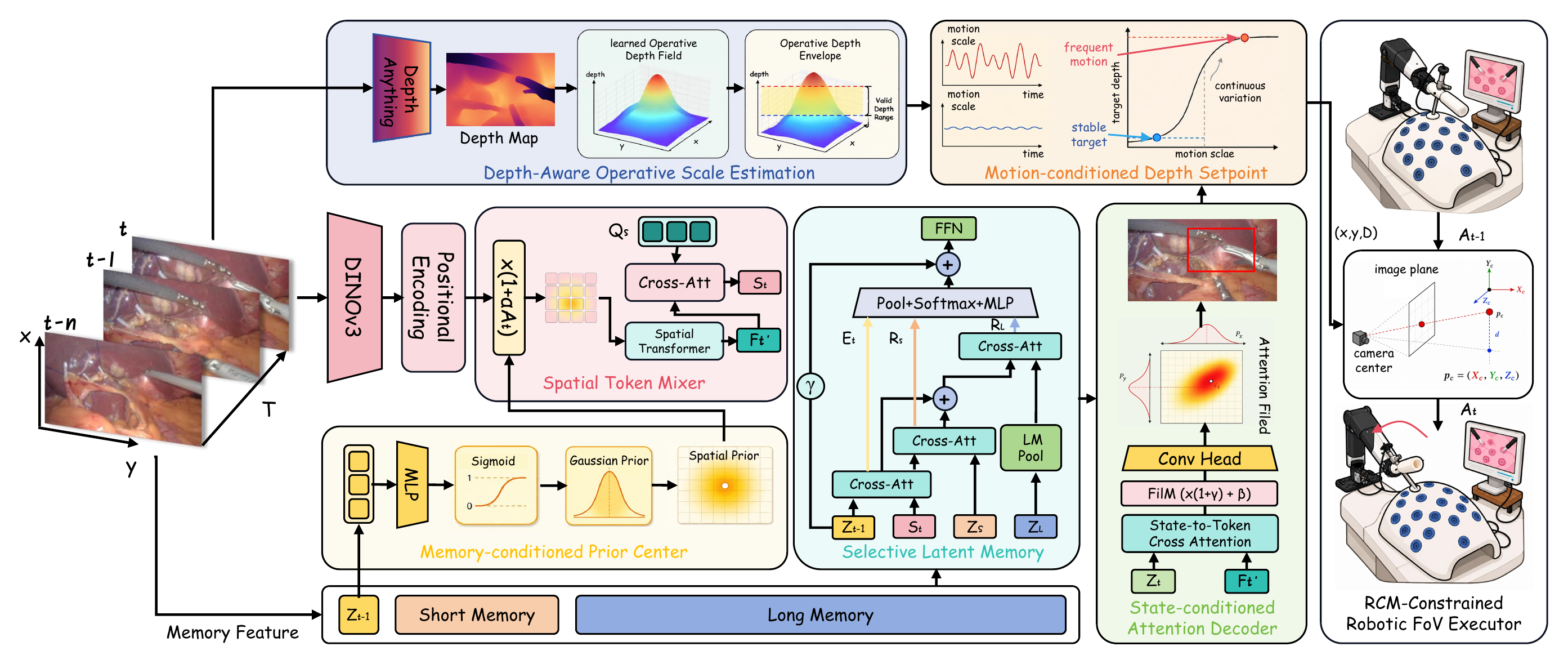
The pipeline combines depth-aware operative scale estimation, motion-conditioned depth setpoint prediction, memory-conditioned spatial priors, spatial token mixing, selective latent memory, and a state-conditioned attention decoder. The decoded operative region and depth target are then sent to an RCM-constrained robotic FoV executor for stable autonomous laparoscope motion.
A frozen DINOv3 encoder and state-conditioned spatial token mixer extract operative cues under a memory-guided spatial prior.
Causal latent memory retrieves current, recent, and historical states to follow short motion continuity and long-horizon intent transitions.
The latent attention state is decoded into heatmaps and operative regions for depth-aware, RCM-constrained laparoscope control.
Each video compares RT-DETRv2, MCITrack, SurgAtt-Tracker, and SurgLAT from left to right.
Four SurgAtt-SZPH clips visualizing operative region tracking with ground-truth-size trackers.
Four SurgAtt-AutoLaparo clips showing cross-dataset robustness across surgical workflows.
Four SurgAtt-Hamlyn clips evaluating tracking under rapid instrument motion and target transitions.
Real-machine videos compare RT-DETRv2, MCITrack, SurgAtt-Tracker, and SurgLAT under the same scene montage.
Autonomous camera adjustment during continuous manipulation on the robotic platform.
View control under target movement and instrument-induced occlusion.
Short sequence highlighting stable tracking during rapid operative focus changes.
End-to-end real robotic assistance with RCM-constrained laparoscope motion.
Four synchronized real-machine operation clips from 30s to 50s are arranged in a 2x2 layout to show automated laparoscopic visualization control across different operating motions.